Vision 2030, our long-term vision for the Takuma Group 10 years in the future, includes this statement: “Aim to maintain our role of being an indispensable presence in society as a leading company in the field of renewable energy utilization and environmental protection by realizing sustained growth alongside our customers and society through implementation of ESG management.” Reflecting the agreement between the direction we seek to pursue in our businesses and the general thrust of social pressure to reduce greenhouse gas emissions and increase the resilience of infrastructure in the face of intensifying natural disasters, we identified “helping combat climate change” as one issue that deserves to be addressed on a priority basis (Materiality), and we announced our support for the recommendations of the Task Force on Climate-Related Financial Disclosures (TCFD) in April 2022. As the Group works to realize its corporate vision, we will strive to enhance initiatives that help realize a sustainable society by resolving issues faced by customers and society through the provision of products and services and by reducing our own CO2 emissions. In addition, we will work to increase the sophistication of our approach to climate change and of our information disclosure initiatives through dialog with stakeholders.
We consider contributing to measures addressing climate change to be an important management priority, and we are pursuing a series of companywide initiatives under monitoring structures put in place by our Board of Directors. The Executive Manager, Corporate Planning & Administration Division (secretariat: Planning Department), who serves as the executive in charge of dealing with climate change, requests or instructs involved departments to cooperate, gathers information about how climate change will impact our businesses as well as associated initiatives, evaluates the risks and opportunities posed by climate change, and reviews the status of related initiatives. This information is then reviewed by the Environment Committee (chairman: Executive Manager, Compliance & CSR Promotion Division) and reported to the Board of Directors following discussion by the Committee of Executive Officers as necessary. The Board of Directors supervises the status of Takuma’s initiatives related to measures addressing climate change through these reports as well as their consistency with the company's business policies (in principle, once a year), and the Board reviews policies as necessary and determines strategy.
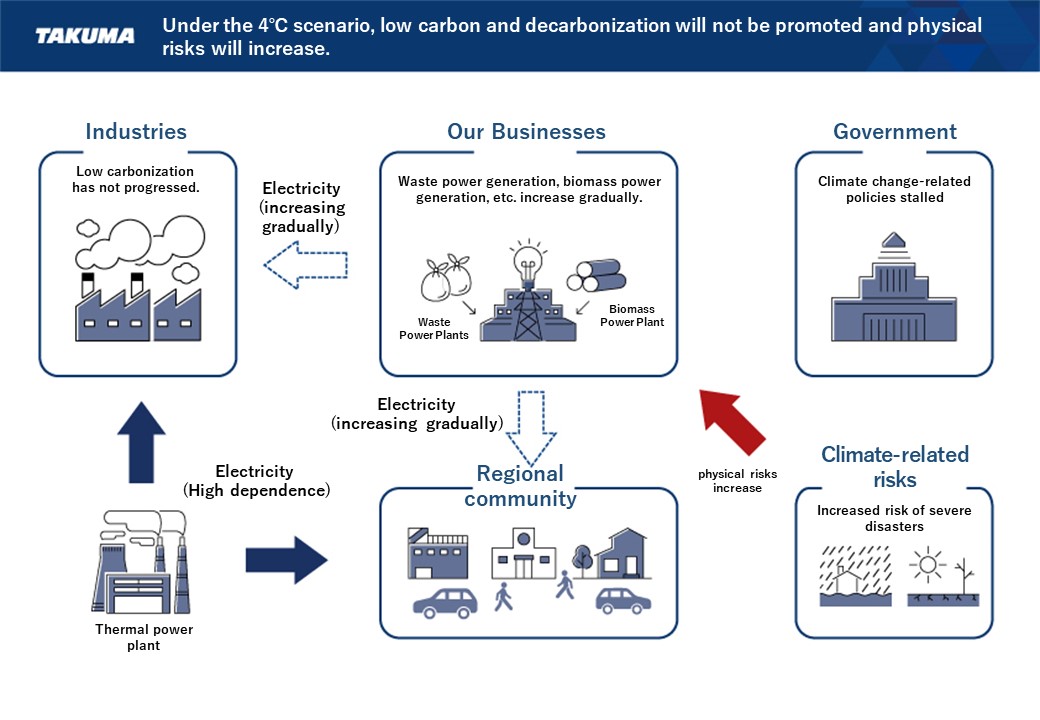
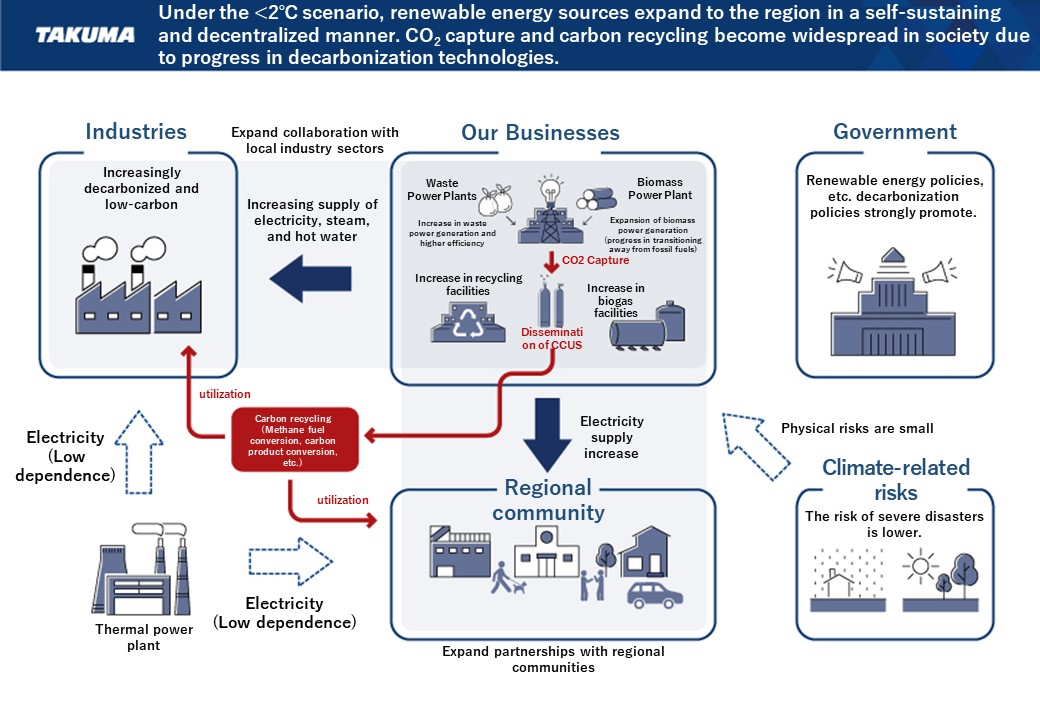
After taking into account multiple scenarios announced by the Intergovernmental Panel on Climate Change (IPCC) and International Energy Agency (IEA), and referring to various materials released by the Ministry of Economy, Trade and Industry and the Ministry of the Environment, we established the two scenarios described below (one assuming a temperature rise of less than 2°C, and the other a rise of 4°C). We then analyzed the two scenarios with a focus on our Domestic Environment and Energy Business, a flagship business that accounts for the majority of the Group’s sales and a segment of our operations that is likely to be affected by climate change. We conducted this analysis through 2040, based on the new policy directions outlined in the 7th Basic Energy Plan and other documents, in an effort to identify the risks and opportunities that climate change would pose for our operations and to summarize the measures that we could undertake to resolve associated issues.
| Established scenario | Overview | Reference scenario(s) | |||
|---|---|---|---|---|---|
| Established scenario | <2°C scenario | Overview | A scenario in which progress in decarbonization restrains the average worldwide temperature increase to less than 2°C, as set forth in the Paris Agreement | Reference scenario(s) | NZE and SDS (IEA); RCP 2.6 (IPCC) |
| Established scenario | 4°C scenario | Overview | A scenario in which a lack of progress in decarbonization results in an average worldwide temperature increase of 4°C or greater | Reference scenario(s) | RCP 8.5 (IPCC) |
Note
NZE: Net Zero Emissions Scenario; SDS: Sustainable Development Scenario; RCP: Representative Concentration Pathways Scenario
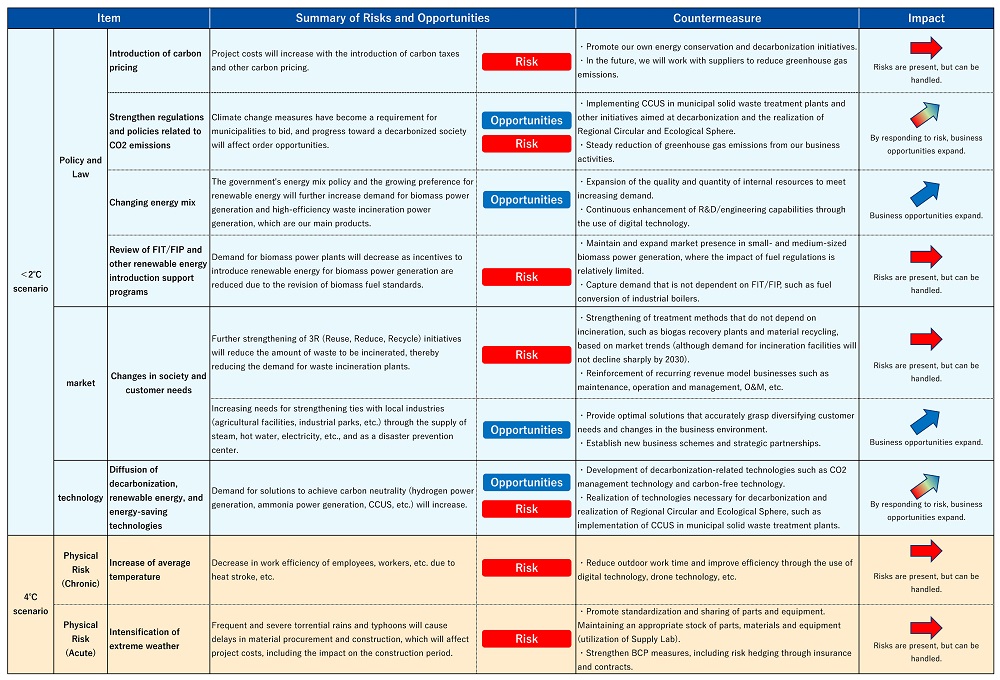
We identified key risks and opportunities after extracting risks and opportunities posed by climate change from the standpoint of all value chains in the analyzed businesses, including sales, engineering, procurement, and construction, and evaluating them using a three-tier scale based on the extent of their impact on those businesses. This year, we conducted a scenario analysis with a target year of 2040 and updated our assessment of risks and opportunities.
Under the <2°C scenario, changes in the energy mix and growing energy-saving awareness combine to drive up demand for flagship products like biomass power and waste incineration power plants, while partnerships between our plants and local industry (agricultural facilities, industrial parks, etc.) are strengthened through our provision of steam, hot water, electricity, and other forms of energy. Set against this expected expansion of opportunities for our businesses are a number of anticipated migration risks, including a reduction in new and replacement demand for waste incineration plants due to stepped-up implementation of the 3Rs (reduce, reuse, and recycle) and accommodation of new needs such as CO2 capture, utilization, and storage (CCUS). To accommodate these developments, we will look to mitigate risks while taking advantage of opportunities to expand our businesses, including by proposing optimal solutions to individual customers; enhancing recurring revenue model businesses like maintenance, operation management, and O&M; strengthening product groups that do not rely on incineration, for example biogas recovery plants and recycling plants; and continuing R&D geared to realizing carbon neutrality, for example in the area of CCUS.
Under the 4°C scenario, frequent and intensifying abnormal weather lead to delays in material procurement and construction, posing potential impacts on business costs, including in the form of schedule impacts. In response, we will work to standardize parts and equipment; to optimize stocks of parts, materials, and equipment at Supply Lab (after-sales service facilities); and to strengthen business continuity planning, for example by establishing sufficient risk buffers and hedging risks through insurance agreements.
In addition, the 14th Medium-Term Management Plan incorporates a strategy through FY2026 that looks toward 2030.
At the instruction of the Executive Manager of the Corporate Planning & Administration Division (secretariat: Planning Department), who serves as the executive in charge of dealing with climate change, a regular (in principle, once each year) review of risks and opportunities with the potential to have a major impact on our management and finances was undertaken, and the results of the associated evaluation and analysis were reported to the Board of Directors after being reviewed by the Environment Committee. The Board of Directors is supervising the status of our initiatives related to climate change through this report. We have put in place companywide risk management structures based on our Risk Management Code, and we have established a risk management team (in the form of the Compliance & CSR Promotion Division) to identify, avoid, transfer, mitigating, and otherwise address risks with the potential to negatively impact our businesses. The Legal Affairs & CSR Department supervises the Environment Committee's secretariat in assessing climate change risk and reviewing the status of initiatives to address it.
As we look to realize carbon neutrality by 2050 as well as Vision 2030, our long-term vision, we will work to resolve customer and societal issues by supplying products and services that contribute to energy conservation and decarbonization while reducing our own CO2 emissions.
*Possible reductions in CO2 emissions from newly delivered power plants (biomass and waste power plants delivered from FY2021 to FY2030)
*Calculated based on the renewable portion of available generating capacity starting during the month after delivery for plants delivered from FY2021 to FY2025.
(Eight Energy from Waste plants, two sewage sludge incineration power plant, 24 biomass and other power plants)
Note 1: The target includes offsets using environmental value such as J-credits.
Note 2: The Scope 2 target is calculated using post-adjustment emission factors.
Note 3: Takuma domestic worksites : Head Office, branch companies, branches, factories, and construction sites
Note 4: FY2030 targets including group companies remain under consideration.
The total Scope 1 and Scope 2 CO2 emissions were 62 t-CO2 at the Takuma Head Office, branch companies, branches and Harima Factory, including offsets based on environmental value for fiscal 2025; they were 432 t-CO2 before offsets.
| Head office ① |
Harima factory ② |
branch companies, branches ③ |
subtotal (①+②+③) |
construction sites (④) |
total (①+②+③+④) |
||||||||
|---|---|---|---|---|---|---|---|---|---|---|---|---|---|
| FY2024 | Scope1 | Head office ① |
254 | Harima factory ② |
154 | branch companies, branches ③ |
4 | subtotal (①+②+③) |
413 | construction sites (④) |
- | total (①+②+③+④) |
413 |
| Of which, credit purchased | Head office ① |
254 | Harima factory ② |
154 | branch companies, branches ③ |
4 | subtotal (①+②+③) |
413 | construction sites (④) |
- | total (①+②+③+④) |
413 | |
| Scope2 | Head office ① |
0 | Harima factory ② |
0 | branch companies, branches ③ |
64 | subtotal (①+②+③) |
64 | construction sites (④) |
- | total (①+②+③+④) |
64 | |
| total (Scope1+Scope2) |
Head office ① |
254 | Harima factory ② |
154 | branch companies, branches ③ |
69 | subtotal (①+②+③) |
478 | construction sites (④) |
- | total (①+②+③+④) |
478 | |
| total | Head office ① |
0 | Harima factory ② |
0 | branch companies, branches ③ |
64 | subtotal (①+②+③) |
64 | construction sites (④) |
- | total (①+②+③+④) |
64 | |
| FY2025 | Scope1 | Head office ① |
258 | Harima factory ② |
106 | branch companies, branches ③ |
3 | subtotal (①+②+③) |
369 | construction sites (④) |
1,017 | total (①+②+③+④) |
1,387 |
| Of which, credit purchased | Head office ① |
258 | Harima factory ② |
106 | branch companies, branches ③ |
3 | subtotal (①+②+③) |
369 | construction sites (④) |
0 | total (①+②+③+④) |
369 | |
| Scope2 | Head office ① |
0 | Harima factory ② |
0 | branch companies, branches ③ |
62 | subtotal (①+②+③) |
62 | construction sites (④) |
1,736 | total (①+②+③+④) |
1,799 | |
| total (Scope1+Scope2) |
Head office ① |
258 | Harima factory ② |
106 | branch companies, branches ③ |
66 | subtotal (①+②+③) |
432 | construction sites (④) |
2,754 | total (①+②+③+④) |
3,186 | |
| total | Head office ① |
0 | Harima factory ② |
0 | branch companies, branches ③ |
62 | subtotal (①+②+③) |
62 | construction sites (④) |
2,754 | total (①+②+③+④) |
2,816 |
Note 1: Totals may not add up due to fractional processing.
Note 2: As of April 2022, all electricity used at the Head Office and Harima Factory had been replaced with non-fossil electricity derived from renewable energy.
Note 3: Purchase J-credits equivalent to Scope1 emissions of the Head Office, branch companies, branches and Harima Factory.
Note 4: CO2 emissions from construction sites will be tracked starting in FY2025.
We recognize addressing climate change as a key management priority and have previously disclosed our Scope1 and Scope2 greenhouse gas emissions. To gain a comprehensive understanding of emissions across our entire supply chain, we have begun disclosing Scope3 emissions for our standalone operations starting with the FY2025.
Our primary business is EPC (Engineering, Procurement, and Construction) for municipal solid waste treatment plants. During the operational phase of these plants, CO2 emissions are generated from the incineration of fossil-derived waste, such as plastics. Consequently, due to the nature of our business, “Category 11 (Use of sold products)” accounts for a significant proportion of our total Scope 3 emissions.
Going forward, we will continue to explore expanding the scope of calculation to include group companies and establishing KPIs for key categories.
| Category | Emissions (Unit: t-CO2) |
|||
|---|---|---|---|---|
| Category | Category1 | Purchased Products and Services | 排出量 | 192,225 |
| Category | Category2 | Capital Goods | 排出量 | 2,423 |
| Category | Category3 | Fuel and Energy-Related Activities | 排出量 | 826 |
| Category | Category4 | Transportation and Delivery (Upstream) | 排出量 | 966 |
| Category | Category5 | Business Waste | 排出量 | 1,046 |
| Category | Category6 | Business Travel | 排出量 | 145 |
| Category | Category7 | Employee Commuting | 排出量 | 374 |
| Category | Category8 | Leased Assets (Upstream) | 排出量 | Not applicable |
| Category | Category9 | Transportation and Delivery (Downstream) | 排出量 | Not applicable |
| Category | Category10 | Processing of Products Sold | 排出量 | Not applicable |
| Category | Category11 | Use of Products Sold | 排出量 | 1,309,014 |
| Category | Category12 | Disposal of products sold | 排出量 | 96 |
| Category | Category13 | Leased assets (downstream) | 排出量 | Not applicable |
| Category | Category14 | Franchising | 排出量 | Not applicable |
| Category | Category15 | Investments | 排出量 | Not applicable |
| Category | total | 排出量 | 1,507,118 | |
Note 1: Categories that do not fall within the scope of our business activities, or those that are included in other categories for calculation purposes, are excluded from the calculation.
Note 2: Totals may not add up due to fractional processing.