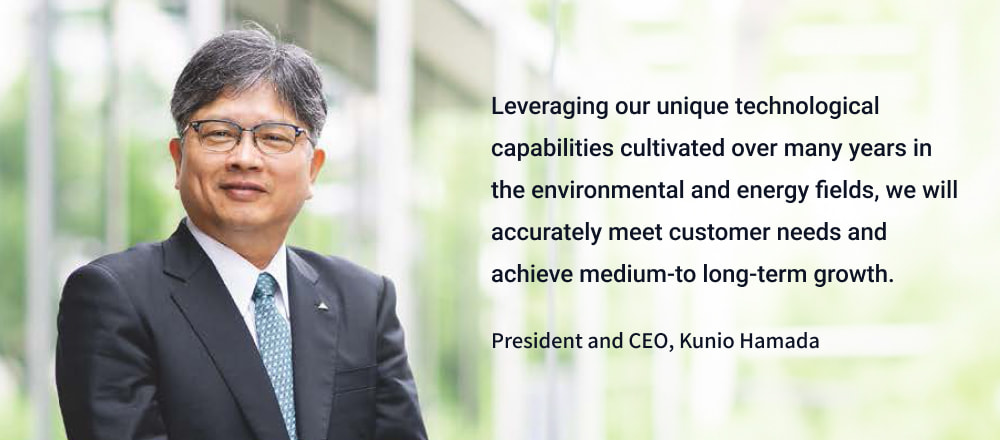
My name is Hamada, and I was appointed President and Representative Director of Takuma in April 2025. We will do our utmost to meet the expectations of all stakeholders, including shareholders, investors, customers, and cooperating companies, for Takuma’s further development. After I graduated from university, I initially worked for another company, but due to the booming domestic market, I was faced with the dilemma of not being able to work abroad, which I had hoped for. I had known about Takuma as a pioneer in the boiler industry since I was a student, and I happened to see an opening for employment and was attracted to the company’s work on overseas projects, so I joined as a career employee at the age of 25. At first, I was assigned to the department of plant design, and when I volunteered to work on the commissioning of the first waste incineration plant project in Taiwan that Takuma was carrying out at that time, I was able to work there for six months on the commissioning. I then spent 12 years in plant design in Japan and Thailand, 15 years in project management, and 7 years in corporate planning.
While I was working in the department of project management, there was a difficult period when we could not get orders for municipal waste treatment facilities as the bidding process was shifting from evaluation based on monetary value alone to a “comprehensive evaluation system” that combined monetary value and technical points. In order to overcome these difficulties, we exchanged opinions with the technical division many times. With the support of consulting companies, we reviewed our proposals and learned that it is important not only to appeal to customers with superior technology, but also to accurately assess what they want and select the appropriate technology to propose, which led to our subsequent success. Even today, the importance of accurately identifying the essential needs of our customers and the community is deeply embedded throughout the company.
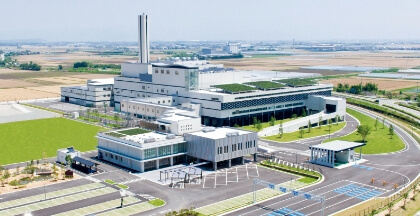
Our company was established in 1938 by Tsunekichi Takuma, who invented Japan’s first purely domestic water tube boiler. While other companies introduced technology from Europe, we developed our own technology from scratch, refined our combustion technology and engineering capabilities, and in 1963 delivered Japan’s first 24-hour operating waste incineration plant to the city of Osaka. Currently, the company’s three main businesses are municipal solid waste treatment plants, energy plants, and water treatment plants.
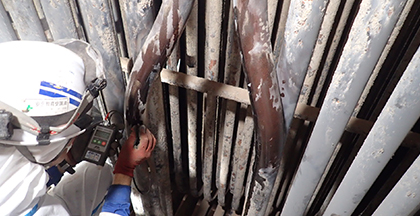
Improving combustion technology requires an empirical engineering approach, and we have grown through trial and error and repeated improvements. For example, if the waste contains a lot of plastics, it has a higher calorific value and is more flammable, but the high chlorine content makes the pipes more susceptible to corrosion. Therefore, it is important to design plants based on an accurate understanding of the quality of waste, which varies according to local sorting rules and lifestyle. Of the waste incineration facilities we have delivered to date, approximately 100 are currently in operation, and our major strength is our ability to research and understand the waste characteristics of each region through equipment maintenance and operation management.
In addition, to achieve the high efficiency of power generation from waste that many customers require, steam temperature and pressure must be increased, which increases the risk of pipe corrosion and boiler failure. We have solved these problems by conducting demonstration tests with our customers, and have evolved our combustion and heat recovery technologies through steady efforts, which has led to our advanced technological capabilities. We are still developing and introducing technologies that will lead to more stable and efficient operation, such as AI-based automatic control of combustion conditions.
To ensure that these technologies are passed on to future generations, we are working to promote knowledge management* that consolidates operational data scattered throughout each department, with the aim of creating a system where even employees in their first year with the company can understand past technological initiatives and responses to customers. We also aim to further strengthen our technical capabilities by holding technical presentations for employees in the technical divisions and training sessions by outside lecturers.
Plants consist of a wide variety of machinery, each of which has its own specialized engineers, and at our company, dedicated personnel maintain close communication with our customers from design through construction, quality inspection, commissioning, and delivery.
For example, a municipal solid waste treatment plant generally takes four to five years from the time an order is received to delivery. I feel that we are building a relationship of trust where we can work together with our clients to solve various issues as we move forward with a project, and upon completion, we can rejoice hand in hand with our clients. Furthermore, in maintenance after delivery, when any problems arise, all departments work together to respond quickly, and our customers appreciate the speed of our response.
In addition, plant specifications and requirements are unique and no two plants are alike. In recent years, in addition to collecting and incinerating waste and generating electricity, there has been a growing need for these facilities to serve as local disaster prevention centers and as educational opportunities for learning about environmental initiatives. We will continue to make proposals that meet the diverse needs of our customers based on the knowledge we have accumulated through our many delivery records.
In 2021, we formulated our long-term “Vision 2030” with the aim of “growing sustainably with our customers and society by promoting ESG management and continuing to be an indispensable presence in society as a leading company mainly in the fields of renewable energy utilization and environmental conservation”. As the second step toward achieving this goal, we are implementing the 14th Medium-Term Management Plan (FY2024–FY2026).
Currently, there are approximately 1,000 waste incineration facilities in Japan, but 70% of these facilities have been in operation for more than 20 years and are aging. We expect steady demand for renewal projects and primary equipment improvement projects (life extension projects) at least until beyond 2030, and we intend to expand our business by steadily capturing this demand.
On the other hand, there are many cases where it is difficult to rebuild facilities due to various factors, and an increasing number of customers are opting for large-scale maintenance work that contributes to extending the service life of their facilities. We, too, will respond to customer needs by focusing on proposals that contribute to extending service life and proposals that lead to energy conservation and decarbonization. In order to strengthen our resources for growth we will also consider M&A, especially in the engineering field and companies in the peripheral fields of our existing businesses, such as material recycling.
In our overseas business, a waste incineration plant in Taiwan, like the one I commissioned 35 years ago, is now due for replacement, and we are determined to win orders for its renewal.
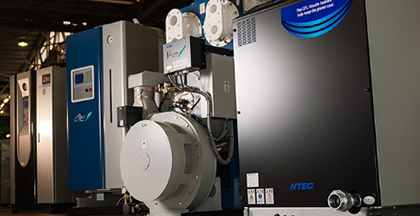
In the package boiler business, IHI Packaged Boiler Co., Ltd. became a consolidated subsidiary in April through M&A in order to expand our share in the general-purpose boiler market. Together with our subsidiary Nippon Thermoener Co., Ltd. we expect our market share for our main product, once-through boilers, to expand to approximately 20%. With the aim of further realizing synergies, the merger of Nippon Thermoener and IHI Packaged Boiler is scheduled to take effect in April 2026.
We are focusing on the development of energy-saving CO2 separation and capture systems using our proprietary chemical absorption method with non-aqueous absorbent solutions. Working backward from the national goal of achieving carbon neutrality by 2050, we hope to establish a certain level of basic technology by around 2030. As a concrete example of our progress, in July 2024, we installed a CO2 capture and recovery system demonstration device at the Maniwa Biomass Power Plant (Maniwa City, Okayama Prefecture), which was delivered by our company, and are now in the process of verifying the system. This year, the “Development and Demonstration of Energy-Saving CO2 Capture and Separation Technology” jointly implemented with Senboku Environmental Improvement Facilities Association in Osaka Prefecture and Universal Energy Research Institute Corporation was selected by the Ministry of the Environment for the “FY2025 Carbon Neutral Technology Development and Demonstration Project for Regional Co-Creation and Cross-Sector Collaboration”. Starting in FY2027, we will proceed with the performance evaluation of a demonstration facility with a CO2 capture capacity of 6 tons per day at the Senboku Clean Center (Izumi City, Osaka Prefecture), a waste treatment facility that is currently in operation.
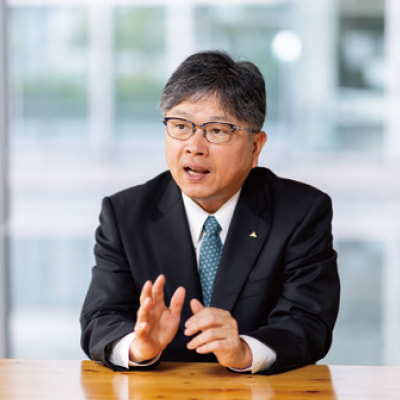
Our business requires a lot of manpower, but with the increasing mobility of young people in the labor market in particular, securing and training stable human resources is a major challenge. We are strengthening our recruitment of both new graduates and career employees, and in recent years we have hired approximately 80 employees each year. To improve employee engagement, we are focusing on enhancing employee training, personnel rotation according to the aptitude of the individual, and efforts to achieve a worklife balance. In the future, we intend to more proactively communicate our company’s appeal and enhance Takuma’s brand power.
I would like employees to have a sense of ownership, to be proactive and inquisitive, and to work on it without fear of failure. I myself have made numerous mistakes, but I have also learned a lot, and turning mistakes into positives leads to growth. Takuma has 1,087 employees on a nonconsolidated basis and 4,372 (as of March 31, 2025) on a consolidated group basis. I believe it is my mission to carry on the culture of working in close proximity to the customer, and to continue to emphasize the importance of a small but efficient workflow, such as rushing to the scene immediately if something goes wrong.
While cherishing what our company has built up to now, such as an open organizational culture where we can respect other departments and frankly tell each other what is good and what is bad, and a culture of working as one to solve our customers’ problems, we will boldly take on new challenges and further grow Takuma. I would like to thank all of our stakeholders for their continued understanding and support of our company.
September 30, 2025
TAKUMA CO., LTD.
President and CEO, Kunio Hamada