We will help alleviate the global problem of climate change using the technology and expertise we have accumulated over more than 80 years.
We’re working to reduce environmental impacts throughout the plant life cycle, including design, construction, operation, maintenance, and improvement, through initiatives to reduce fuel consumption and improve generating efficiency by boosting plant efficiency and to reduce CO2 emissions through energy savings.
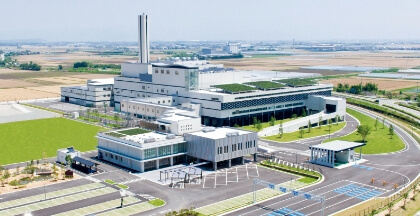
Since delivering Japan’s first 24-hour operating waste incineration plant in 1963, Takuma has built and delivered more than 370 municipal solid waste treatment plants, the most of any manufacturer in Japan. Most of the treatment technologies used by plants are the result of in-house R&D by Takuma, which continues to embrace the highest standards of excellence while working to refine its technologies so that they can accommodate the needs of society it changes over time. Takuma contributes to resource conservation and environmental protection through a broad product line and after-sales service based on an extensive track record as the industry’s leading company.
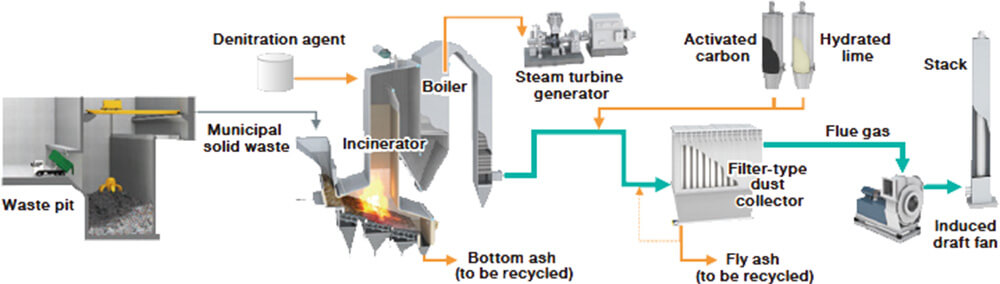
Equipment sequence at a high-efficiency, low-environmental-impact municipal solid waste treatment plant
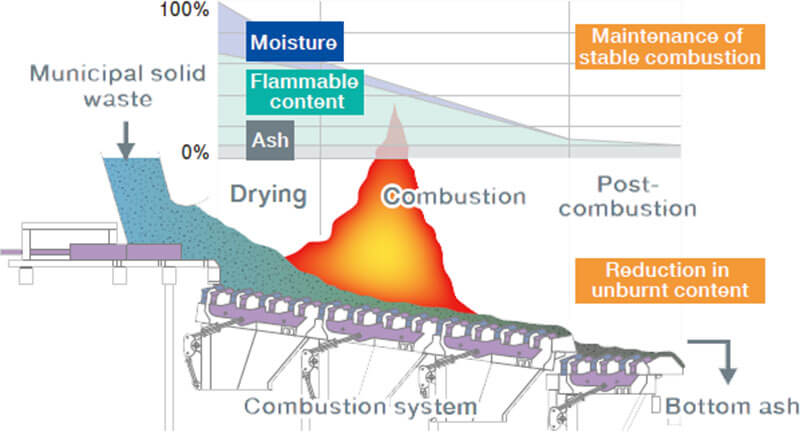
High-performance stoker furnace
Takuma stokers incorporate enhancements and improvements that draw on our track record of deliveries, which makes us the No. 1 supplier of such systems in Japan, along with our treatment experience. We pursue ash recycling by maintaining stable combustion despite a diverse range of waste properties and creating bottom ash with few embers that exhibits uniform properties, making it well suited for use in cement recycling.
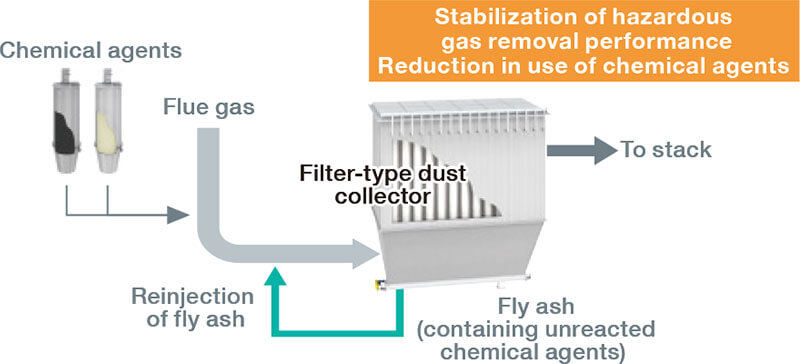
Fly ash circulation system
Fly ash collected by filter-type dust collectors contains chemical agents used to remove toxic chemicals (hydrated lime and activated carbon) that are still capable of removing toxic chemicals. This system consists of technology for utilizing such chemical agents to maximum effect by reducing chemical agent use and fly ash volume so that fly ash can be recycled efficiently and economically.
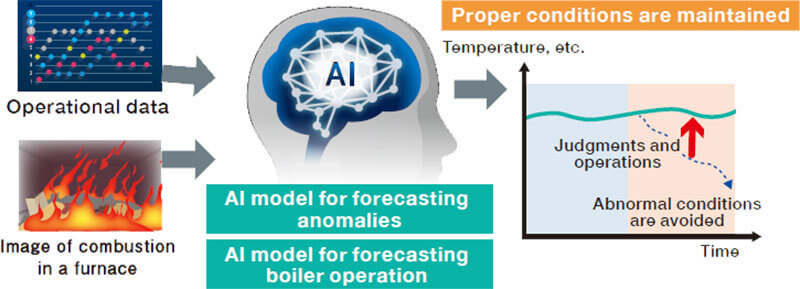
AI-enabled combustion control system
This next-generation combustion control system, which uses AI technology, reproduces the operational skills of experienced operators. Since the system precisely forecasts combustion fluctuations that are unique to waste incineration to determine and implement the appropriate response, stable combustion conditions can be maintained at all times, even when the properties of the waste fluctuate over the medium and long-term.
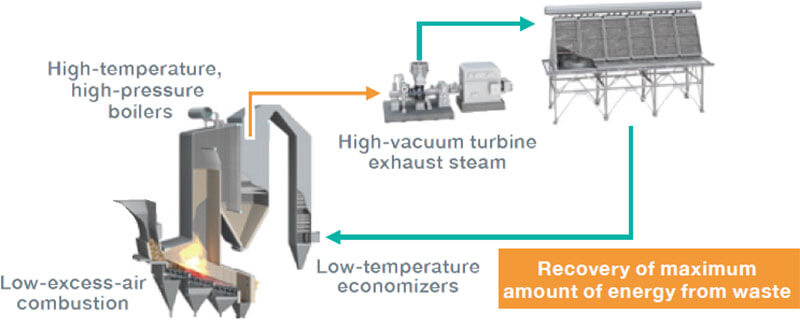
High-efficiency power generation system
Municipal solid waste treatment plants demand high-efficiency power generation technology from the standpoint of reducing CO2 emissions. We help protect the Earth’s environment through such technology, including high-temperature, high-pressure boilers; low-excess-air combustion; low-temperature economizers; and use of high-vacuum turbine exhaust steam.
Since entering the water treatment business in 1962, Takuma has manufactured a variety of water treatment equipment over the course of more than 60 years while working to protect the water resources required by society and the greater water environment. In recent years, companies in this sector have been called upon to address social needs involving priorities such as energy conservation, energy creation, and Life Cycle Cost (LCC) reductions. In response, we have helped realize sustainable sewage systems by taking advantage of the reliable technology and extensive experience we have developed to date.
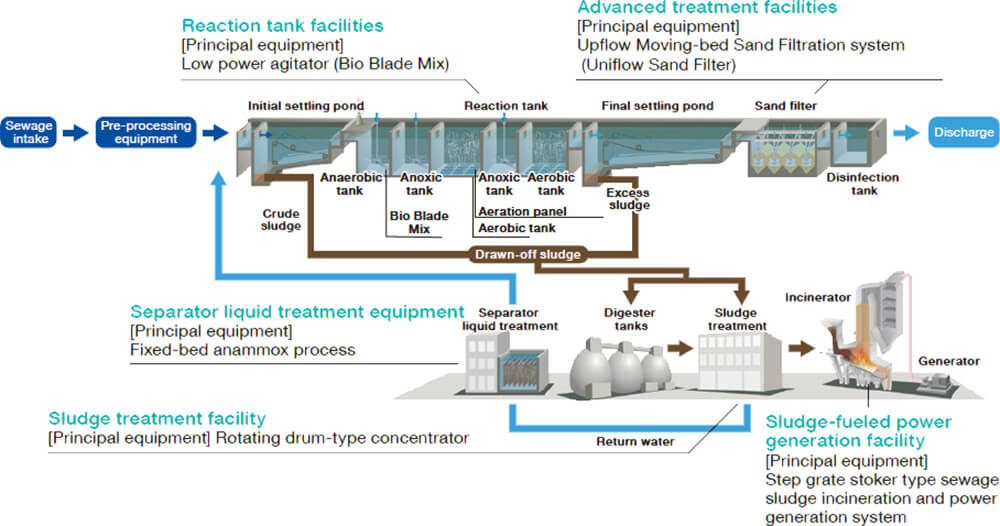
Processing flow in water treatment plant equipment at a sewage facility
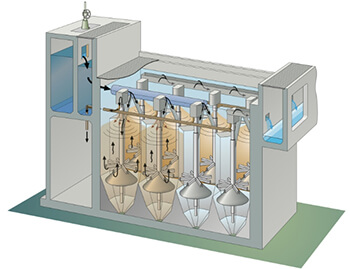
Upflow moving-bed sand filtration system
Our upflow moving-bed sand filtration system (Uniflow Sand Filter), which removes Suspended Solids (SS) from water, is primarily used for final treatment at sewage treatment plants to allow clean, treated water to be released into rivers. Some treated water is also reused at the facility, helping to conserve water resources. Uniflow Sand Filter systems boast top domestic market share in moving-bed sand filtration systems, and we have delivered more than 2,800 of these long-selling products, which feature water quality purification technology, in Japan. In recent years, many of the systems we have delivered have been a new high-speed model that delivers two to three times the treatment volume with the same area as conventional fixed-bed sand filtration systems. We are also seeing more projects that replace fixed-bed sand filtration systems with this system while retaining existing foundation work and related infrastructure.
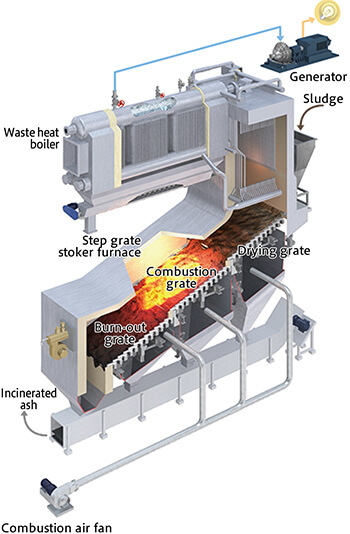
Step grate stoker type sewage sludge incineration and power generation system
Sludge generated by the sewage treatment process is a type of biomass, and such resources are expected to be used as renewable energy. Conventional sludge incinerators were net consumers of energy because they required auxiliary fuel and used large amounts of electricity, but this system draws on the core Takuma technologies of combustion technology and boiler technology to make possible an energy-creating system that generates more power than the incinerator consumes while using sludge as fuel, as long as it operates at or above a certain scale.
The Japan Society of Industrial Machinery Manufacturers has established a series of targets to be achieved by FY2030 based on the Japan Business Federation’s action plan. Takuma participates in the Committee on Environmental Equipment, of which we serve as the deputy chair, and in other committees. We provide our views on decarbonization in response to the Society’s initiatives, and we participate in decarbonization initiatives and climate change measures undertaken by the Society.
The Japan Environmental Facilities Manufacturers Association is an industry organization that works to realize decarbonization through waste and to build a Sound Material-Cycle Society founded on resource recycling and a Regional Circular and Ecological Sphere. Takuma participates by serving as a trustee and as a member (or chair) of various committees. By presenting and applying its views to the Japanese government and industry through various committees, the Association is working to realize decarbonization and to build a Sound Material-Cycle Society and a Regional Circular and Ecological Sphere.
We’ve participated in this organization, which emphasizes the commercialization of revolutionary technologies (decarbonization, CCUS, etc.) related to carbon-to-X (C2X) through inter-industry partnerships and collaboration among multiple companies with the goal of realizing carbon neutrality and a decarbonized society, from its founding.
We announced our support for the recommendations of the Task Force on Climate-Related Financial Disclosures (TCFD) in April 2022. As the Group works to realize its corporate vision, we will strive to enhance initiatives that help realize a sustainable society by resolving issues faced by customers and society through the provision of products and services and by reducing our own CO2 emissions. In addition, we will work to enhance our approach to climate change and our information disclosure initiatives through dialog with stakeholders.
We’ve been a signatory to the United Nations Global Compact, which sets forth 10 fundamental principles in the four areas of human rights, labor, environment, and anti-corruption, since 2006, and we operate our business in accordance with our understanding of, and respect for, these shared global principles.