TAKUMA and its group companies have established our management principles to strive for social contribution, corporate value enhancement, long-term corporate development and all stakeholders' satisfaction by yielding goods and services needed and recognized as valuables in society.
However, even though we provide good products and services of high quality, if these are produced through antisocial behavior, the existence of the company would never be socially accepted. We believe that the code of conduct - based on which our group companies will sustainably live in harmony with society - is compliance.
Although compliance generally means to observe laws or ordinance, our group considers, it also includes compliance with internal regulations and the concept of ethics and morality in order to address CSR (Corporate Social Responsibility) from a broad perspective.
In accordance with the priority subject of the 8th mid-term management plan, the TAKUMA group companies newly launched the Compliance & CSR Promotion Division, which represents a further development of our previous CSR Promotion & Auditing Department, in April this year. Based on the initiatives of the aforementioned division, we pledge to further promote the improvement of compliance-related regulations and establishments, bearing in mind that it is absolutely up to individual members to practice such compliance.
I as the chief executive officer hereby declare, together with all directors and employees of our group companies, that we pledge to direct both the organization and individuals toward compliance, based on the concept that the implementation of compliance by individuals forms our corporate principles, eventually leading to our management principles.
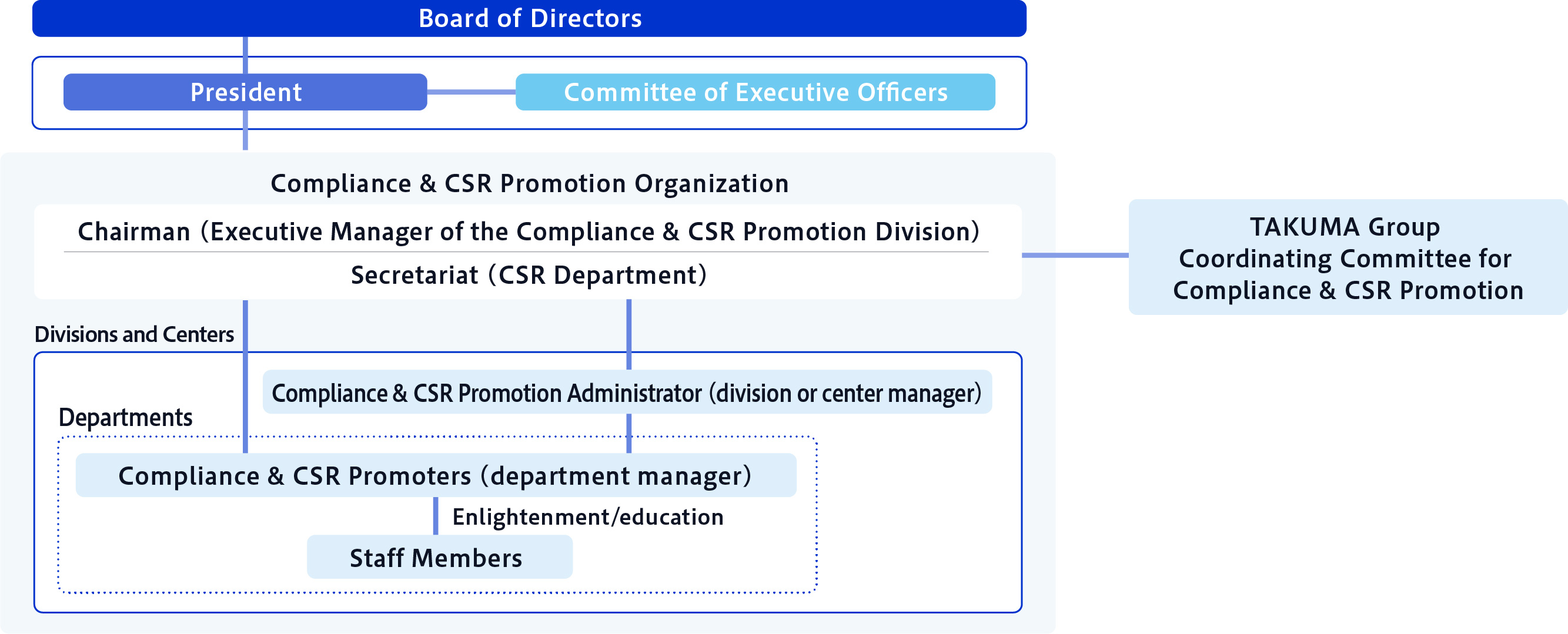
Compliance and CSR Promotion Structure (As of September 30, 2025)
Led by the department in charge of compliance and CSR promotion (Legal & CSR Department), TAKUMA aims at encouraging proper activities through the Compliance & CSR Promotion Organization which was installed for the purpose of enabling compliance and CSR to concretely permeate company-wide through an in-house organization.
The initiative includes an annual regular meeting at which Compliance & CSR Promotion Administrators discuss the state of compliance and CSR promotion throughout the company as well as quarterly departmental meetings at which Compliance & CSR Promoters are given training (including e-learning) to help them better carry out related activities in their departments.
Additionally, the TAKUMA Group Coordinating Committee for Compliance & CSR Promotion is held twice a year for representatives of group companies to help ensure that compliance and risk management are implemented throughout the group.
TAKUMA implements compliance and CSR promotion training for all employees through the Compliance & CSR Promotion Organization.
We cover the Anti-Monopoly Act, insider trading, and other topics on a regular basis as part of our education and training programs, and we strive to eliminate unfair business practices. During the first educational session of each year, we foster understanding and awareness of topics including insider trading management rules, and our manual concerning organized crime and other anti-social forces as shared, company-wide risk countermeasures under our risk management system. We also spread detailed awareness of topics such as the Ethical Rules for Employees of Government Agencies and Local Public Bodies, for example by having trainees read from our Compliance Manual, and we strive to ensure compliance while working actively to eliminate all forms of bribery and corruption.
In addition, we explicitly cite the importance of respect for fundamental human rights in documents such as the Ethics Charter and Code of Conduct, and we spread awareness of associated provisions through internal educational and other programs. Specifically, human rights awareness-raising activities, such as LGBT education in harassment prevention education, are being promoted as part of education on sexual orientation and gender identity.
| Session | Theme | ||
|---|---|---|---|
| Session | First session: | Theme | Corporate Scandals Internal Reporting System |
| Session | Second session: | Theme | Basics of the Subcontracting Act in Light of Recent Amendments |
| Session | Third session: | Theme | Basics of Security Export Controls 2026 Understanding the Current State of Worsening Environmental Issues |
| Session | Fourth session: | Theme | Initiatives to Prevent Harassment - Creating a Workplace Where Everyone Can Thrive - |
We have identified the strengthening of corporate governance as a key issue (Materiality) related to ESG, and we’re aware of the cessation of businesses and decline in social trust that could result from violations of laws related to competition, bribery and corruption, and the environment as risks. Specifically, we’re working to continue appropriate internal audits, enhance the effectiveness of risk management activities, and offer compliance education on an ongoing basis.
Towards ensuring permanent compliance with the Antimonopoly Act, TAKUMA enacted "Regulations Concerning Management of the Pledge of Antimonopoly Act Compliance," which provides for the submission of a written oath in regard to observing the Antimonopoly Act.
"Rules on Controlling Contact with Competitors’ Sales Departments, etc.," defines the procedure for an employee when interacting with the sales department, etc., of a competitor and specifies that an application should be made to and an approval should be obtained from the affiliated division or center manager and the compliance management department in advance and a report is to be made after contact to ensure fair business contact.
The Takuma Group is a signatory to the United Nations Global Compact, and we support its 10 fundamental principles in the four areas of human rights, labor, environment, and anti-corruption. In addition, the Board of Directors has adopted the Takuma Group Ethics Charter and the Takuma Group Code of Conduct, and we strive to spread awareness of their provisions at the Takuma Group. Part of that effort includes detailed training on the Ethical Rules for Employees of Government Agencies and Local Public Bodies.
Participation in The UN Global Compact
The TAKUMA Group Ethics Charter
Takuma Group Code of Conduct (excerpt)
Officers and employees shall comply with laws including the Political Funds Control Act, Public Offices Election Act, and National Public Service Ethics Act when engaging in transactions with public bodies or making political contributions. They shall avoid not only violations of applicable laws, but also conduct which invites questions concerning its legality.
(1) Officers and employees shall not entertain or give gifts to employees of government agencies or local public bodies (including former employees), or to public servants of other countries (including former public servants).
(2) Officers and employees shall not deviate from standard business practices when being accepting entertainment or gifts.
Basic Policies Concerning the Development of the Internal Control System and Status of Their Implementation (excerpt)
Basic policy
Directors, executive officers, and employees shall strive to comply with the Takuma Group Ethics Charter and the Takuma Group Code of Conduct, which set forth a standard of conduct.
Overview of status of implementation
The Takuma Group Ethics Charter and the Takuma Group Code of Conduct shall be distributed to directors, executive officers, and employees, and the Company shall work to ensure awareness of their provisions.
The basic contract and basic construction contract we use for new business partners include provisions concerning the exclusion of anti-social forces. In addition, we’ve compiled a set of CSR procurement guidelines with clear provisions to prevent corruption, and they require business partners to cooperate with associated measures. In addition, the form we use to consider whether to establish a business relationship with prospective manufacturers includes a "non-involvement with anti-social forces" checkbox. Moreover, in credit management, we review the status of efforts to address anti-social forces based on credit information published by credit agencies when evaluating business partners.
When forming joint ventures (JV), we enter into agreements with the company forming the JV by the bidding date. Those agreements include provisions related to legal compliance and relationships with anti-social forces.
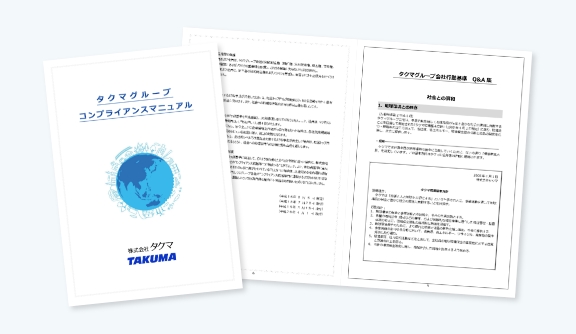
Since 2006, we have been distributing a Compliance Manual that includes an explanation of the rules and standards of conduct as well as an FAQ to all employees in accordance with The TAKUMA Group Ethics Charter and the TAKUMA Group Code of Conduct. This manual is utilized in the course of daily operations and departmental training.(Distributed only in Japanese.)
TAKUMA has been operating an internal reporting system since FY2006, with the aim of promoting compliance management by preventing illegal or unfair acts, and uncovering as early as possible and undertaking corrective measures.
Reporting contacts are set up at our Audit and Supervisory Committee and Compliance & CSR Promotion Division, and at an outside law office as well as a dedicated external expert company for anonymous e-mail reporting. Our “Internal Reporting Code” and the TAKUMA Group Code of Conduct further declare that no informant shall be subjected to disadvantageous treatment simply because he or she filed a report.
Furthermore, in order for the Internal Reporting System to be correctly understood and utilized, we work to raise awareness, publish information on the corporate intranet, and distribute a compliance manual and “Compliance Card” with contact information for our reporting hotlines to all employees. In addition, we administer e-learning programs covering prevention of harassment in the workplace and the Internal Reporting System to all newly hired workers (including outside employees). Many past reports concern bullying, abusive behavior, or harassment, which we deal with internally.
Internal rules require that workers whose responsibilities include the Internal Reporting System be drawn from the main career track or higher positions, and those workers undergo outside training when they are assigned to those positions or engaged in the work. In addition, they participate in outside workshops where they learn how to do their jobs and study incidents that have occurred at other companies.
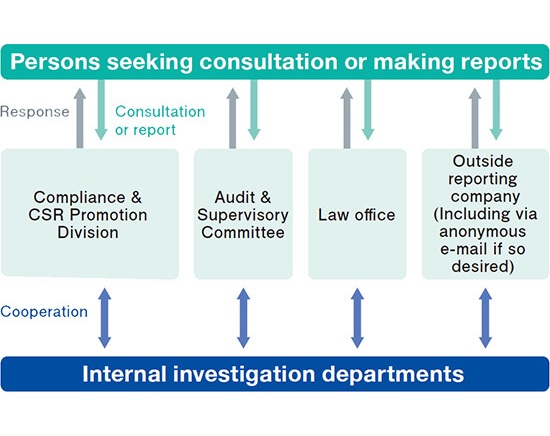
Internal reporting process
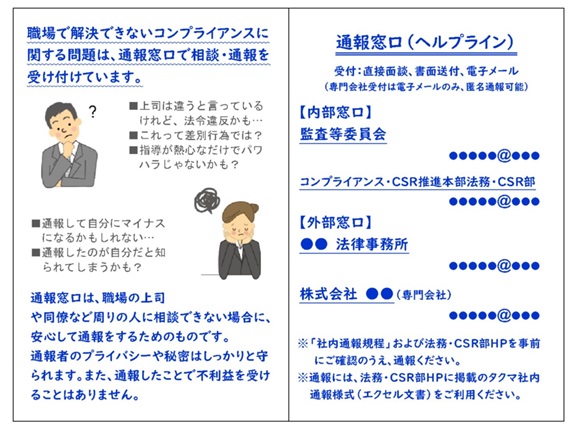
Compliance Card
We have been conducting a CSR Awareness Survey since FY2008 in order to quantitatively assess the level of compliance and CSR awareness along with the effectiveness of related promotional and educational efforts. The results of this survey are used when summarizing the activities of each fiscal year and in formulating the upcoming year’s action plan, as well as in future compliance and CSR promotion activities. The survey was expanded to include group companies in FY2013.
We use the results of the survey to improve compliance and CSR promotion activities on an ongoing basis, for example by implementing education about the items whose scores fell from the previous survey.
Based on the results of the CSR Awareness Survey, which is administered annually to all officers and employees, we’ve determined that respondents’ conduct accords with the Company Motto, Management Principles, Ethics Charter, and Code of Conduct, and that those standards of conduct are functioning effectively. In addition, the results of the CSR Awareness Survey are reported to the Board of Directors.