As Japan’s population continues to decline, it is important to secure a diverse workforce regardless of age, gender, or nationality and create an environment where a diverse workforce can continue to be active over the long term, in order to maintain and expand our business. We will improve our personnel systems and workplace environment to ensure the sustainable growth of the Takuma Group in the future.
In FY2025, we secured a total of 12 female employees in main career track and management positions (4 new graduate hires, 7 career hires and 1 regular employee conversion), bringing the total number of female workers in main career track and management positions to 52 from FY2021 to FY2025.For more details, please refer to the "ESG Data" page.
As one of the KPIs of important issues (materiality) and the general business owner action plan based on the Act on the Promotion of Women’s Advancement, we aim to secure at least 35 new female workers in main career track and management positions between FY2021 and FY2025 through hiring and promotion from general clerical positions to main career track positions.
In hiring new graduates, we will strive to increase contacts with female students by participating in corporate research projects for female students held by local governments, attending information sessions hosted by women’s colleges and joint information sessions for female students, etc. In career hiring, we will discuss hiring of women with the departments that request job openings and increase the number of positions in which women can play an active role.
Women still remain underrepresented within the Company, particularly in core career-track positions (percentage of women in management positions: approximately 2%), where only a small number are currently employed. As a result, there are limited role models available for younger female employees when considering their career paths. To support each female employee in building her career with a clear sense of purpose, we hold career design workshops and roundtable discussions on an irregular basis, providing opportunities for reflection and professional growth.
With the number of mid-career hires increasing, we conduct a training program in the fall of the second year after joining the Company to help mid-career hires build internal networks and enable them to become productive contributors at an early stage.
This training is provided for section managers in departments that accept mid-career hires, with the objective of equipping them with the skills required to effectively manage and support mid-career employees.
In order to realize our longterm vision, Vision 2030, it is necessary to have our senior employees take advantage of their wealth of knowledge and experience. People reach a turning point in their 50s in terms of physical strength, health, family environment, etc. In their professional lives, while they can make use of their wealth of knowledge and experience, it is also important to change their past experiences and conventional ways of thinking and values as necessary due to technological development and diversification of values.
We are implementing education (e-learning) aimed at providing employees in their 50s with opportunities for learning and gaining awareness through selflearning so that they can both make use of their existing knowledge and experience and be exposed to new ways of thinking and values, and work with vigor and enthusiasm.
In order to focus on support for employing people with disabilities, we established a specialized department within the Human Resources Department in April 2020. In addition to assigning a person in charge of support for employing people with disabilities, we are working to support and retain people with disabilities in the workforce, with the help of organizations that provide support for employing people with disabilities.
People with disabilities are engaged in various tasks such as cleaning the office, data processing, sorting and sending mail and parcels, and ordering business cards, according to their respective characteristics.
We strive to secure human resources by visiting schools that support persons with disabilities, accepting students for on-the-job training, and participating in joint job interviews.
We have set a KPI of 25% (FY2021-2025 average) as our target for the rate of utilizing the parenting support programs (childcare leave, maternity/paternity leave, flextime work, telecommuting, and short-time work). This is more than double the FY2020 level.
As a result of introducing the following programs as support measures to enable employees to balance work with childcare/elderly care, and by providing detailed information about these programs to employees who have had children, we achieved the average utilization rate of 49% in FY2021-2024. For more details, please refer to the "ESG Data" page.
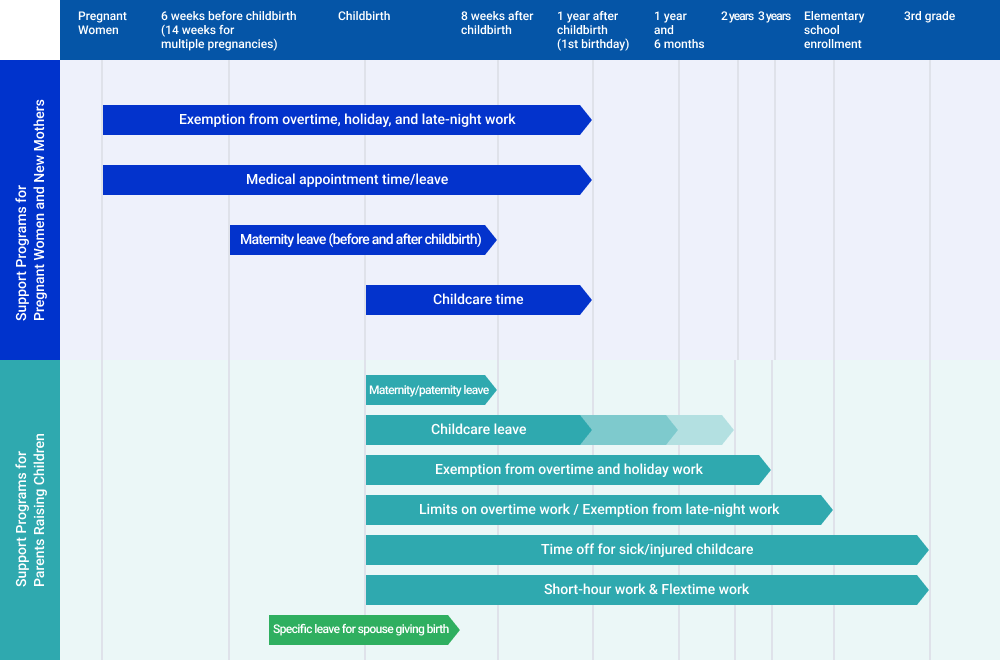
When the spouse of a male employee gives birth, the employee may request three days of special leave during the period from the onset of labor up to within two weeks after the birth.
Employees raising a child who has not yet reached one year of age are eligible to take childcare leave. In addition, within eight weeks after the birth of a child, employees may take up to four weeks (28 days) of leave, divided into one period at the time of birth and one period for childcare leave.
Employees raising a child who has not yet entered elementary school may request leave to care for the child or to accompany the child for vaccinations or health checkups.
Employees who are caring for a family member requiring long-term care may take family care leave up to three times per condition requiring care for each eligible family member, for a cumulative period of up to one year.
Employees raising a child up to the completion of the third grade of elementary school may apply for reduced prescribed working hours (shortened working hours for childcare). In addition, such employees may request to use the flextime system.
To improve productivity and support a balance between work and personal life—such as childcare, caregiving, or medical treatment—we have introduced a remote work system that allows employees to work from home or other locations up to two days per week.
We have children ages 2, 6, and 10, and we both work. Until now, when one of our kids gets sick, we’ve used the childcare program for kids recovering from sickness, and when that’s not available, we’ve adjusted our schedules or used annual paid leave or half-day paid leave. The availability of a work-from-home option has been extremely helpful for our family.
(Male, 40’s, main career track)
Since my child is in a lower grade level of elementary school, I am using telework when I need to stay home with my child in the events of sickness that require hospital visits, and school closure due to warnings issued. This system has been very helpful as I can reduce the burden on either the family (child) or work when I am not there.
(Male, 40’s, management position)
Because our first child still requires a lot of care at age 3, I took child-raising leave for about 11 months starting one month after our second child was born so that my wife could go back to work. I consulted with my supervisor before returning to my position, and now I’m working in the same department as I was before I took the leave. Thanks to the support of my supervisor, colleagues, and the company, I’ve been able to participate in the same work as I did before taking the leave.
(Male, 20's engineering employee)
When I learned my wife was pregnant, I was filled with joy at the prospect of welcoming a new family member. At the same time, I was worried about asking my wife to care for our new child by herself, since there’s nobody nearby we can depend on for help after the birth. Those concerns were eased when I was able to use the childcare leave program, thanks to the understanding and cooperation of my workplace colleagues and supervisor. Since I was able to help out with childcare and household chores, despite not being very familiar with either, my wife was happy, and I was able to watch our child’s rapid growth from an up-close vantage point.
(Male, 30's engineering employee)
| FY2022 | FY2023 | FY2024 | FY2025 | |
|---|---|---|---|---|
| Number of male employees whose spouses gave birth | 34 persons | 52 persons | 33 persons | 33 persons |
| Number of male employees who took childcare leave | 11 persons | 24 persons | 22 persons | 23 persons |
| Percentage of employees taking childcare leave, etc. | 32.3% | 46.1% | 66.6% | 69.6% |
| Number of male employees who took leave for childcare purposes only | 19 persons | 13 persons | 7 persons | 2 persons |
| Percentage of employees taking leave,including leave for childcare purposes | 88.2% | 71.1% | 87.8% | 75.7% |