The treatment technologies that were employed at the crushing and recycling facilities for municipal waste were initially more for the crushing facilities, consisting mainly of crushers, to help in smooth feeding of combustible bulk refuse, such as "Tatami" straw mats, "Futon" bedding, and furniture, into the incinerator. However, as the country has moved into the era of mass consumption and mass disposal as a result of high economic growth, emphasis has been placed more on sorting technologies to help in recycling and in reduction of the volume of the waste that goes for final disposal. Furthermore, as the sorted collection of waste progresses, with the institution of various laws and regulations relating to recycling, disposal systems have been diversified and at the same new disposal technologies have been introduced. Also, facilities have been built and improved for the edification of local residents to curb the generation of waste. This paper summarizes the changes and trends in waste-treatment technologies, including those for crushing and sorting.
(Abstract)
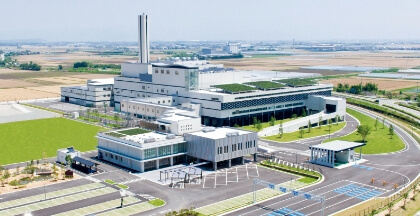
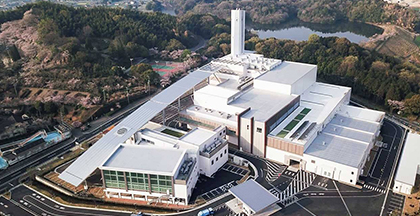
We had delivered a refuse-incineration power plant to Suita Municipal Office in March 2010.
This refuse-incineration power plant positively recovers heat generated in the course of incinerating refuse and then, generates electric power with the heat. Simultaneously, by availing of the generated power, the plant melts incineration slag and fly ash via an arc melting furnace.
After implementing trial runs for performance testing for about six months, it was proven that both the incineration facility and the melting facility satisfied the respective design capabilities, and further, the exhaust-gas measured value and the molten slag leaching test value fully satisfied the respective reference values.
(Abstract)
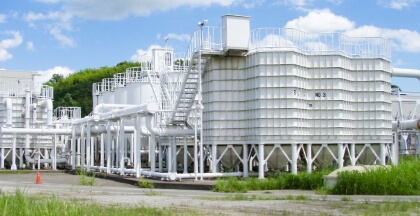
Along with the spread and upgrading of the sewerage system, it has been desired to develop more efficient treatment systems with due considerations to cost for the construction of a sludge treatment facility, and its maintenance and operation, and also to the measures for global environment protection, including the prevention of global warming.
In the systems commonly employed for conventional sludge treatment, raw sludge is thickened by gravity and the excess sludge, with a centrifugal thickener. The respective types of thickened sludge are mixed and then centrifugally dehydrated. In contrast, the writers together with others have conducted tests for evaluation of the treatment performance of a sludge-treatment system by considering energy saving, low cost, and space saving to concentrate and dehydrate mixed raw sludge using a rotating drum-type thickener and high-efficiency screw-type dehydrator (manufactured by Ishigaki Company, Ltd.).
The test result revealed that the subject treatment system performs as or better than the conventional systems and also that electric power and chemicals costs can be reduced by 60-70% and Co2 emissions, by 30-50%.
Incidentally, this report presents part of the results of a joint research program with Sewerage Bureau, Tokyo Metropolitan Government.
(Abstract)
As part of the "Kyoto Bio-cycle Project" a project of the Ministry of the Environment for development of global warming countermeasure technologies, testing was conducted for verification of biogas recovery from by-product glycerin and also for check of safety of the by-product glycerin receiving and charging system in an attempt for effective use of glycerin-containing wastes by-produced from the BDF production process.
As a result of the continuous operation of thermophilic dry methane fermentation of mixed by-product glycerin and kitchen waste (about 4% of by-product glycerin mixture ratio), it was confirmed that there was 1,140m3N/ton-by-product glycerin of biogas generation, approximately the same with 1,080m3N/ton-by-product glycerin, which had been obtained in the basic research phase. It has also been confirmed through the laboratory and field tests that the concentration of combustible ingredients in the volatile gas will not reach the explosion limit when stored at 40℃ by diluting by-product glycerin twice and that thus safety operation is possible though there may be certain variations in concentration of by-product glycerin at the time of its receiving.
(Abstract)
While the construction and operation of boilers using woody fuel and other biomass fuels have been popular, it has been getting more difficult to secure woody fuel because of the increase in the demand for it in recent years. RPF has attracted attention as a substitute for these biomass fuels and also for fossil fuels.
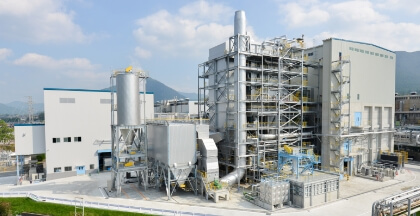
This paper reports the outline of the facility plan and the results of the operation of the RPF-fired fluidized bed boiler plant that was delivered to Kaga Paperboard Manufacturing Co., Ltd., Ishikawa Prefecture, in July 2009. The subject plant, consisting of a RPF-fired cogeneration system, has achieved favorable combustion state in the performance test and it has been verified that it is capable of delivering the performance required to meet the design specifications. Also, it is found that it clears the regulation values related to environmental pollution, including those for effluent gas and incineration ash.
(Abstract)
A epochal high-efficiency reactor vessel and the catalyst that is highly active at low temperatures for methanol synthesis have been developed with a view to establish a system for biomass gasification and methanol synthesis due to increasing a use for a small amount of local biomass energy.
A copper / zinc catalyst, which retains a high level of activity under the temperatures as low as 200℃ and is also highly durable, has successfully been developed by improvements in the dispersibility of copper and thermal conductivity of the catalyst.
As a result of the demonstration test to verify the performance of the newly developed catalyst, the stable yields of methanol were attained and no deterioration was observed over one month of continuous operation.
(Abstract)
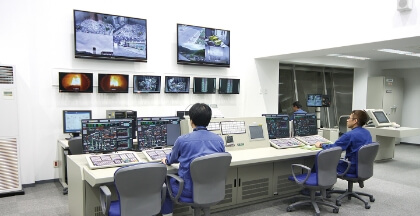
The "total operational support system (TIPLOS †)" to provide total remote operation support services using the Internet, whose operations started in April 2004, is connected to ten domestic refuse incineration or ash melting plants and one overseas refuse incineration or ash melting plant, as of March 2010.
While some of the functions of the subject system were described in the previous report (Vol.12, No.1, 2004), this issue covers cases of operation of the system after introducing the remote monitoring and analysis / reporting services, consisting mainly of DSC displays monitoring, ITV displays monitoring, and alarm monitoring, and also the proposals concerning the support to DBO projects as tasks for the future.
† TIPLOS stands for Takuma Intelligent Plant Observation System.
(Abstract)
A variety of efforts have been made to reduce CO2 emissions for prevention of global warming. The fuel conversion to city gas consisting mainly of natural gas, which is the most environmentally-friendly among the fossil fuels, is part of such efforts, and further enhancement of the efficiency of the system is required. Against such a background, TAKUMA delivered a city gas-fired boiler to Energy Advance Co., Ltd. to be installed within the premises at the Ashigara Site of the Kanagawa Factory, Fujifilm Corporation.
This city gas-fired boiler is intended to replace the existing heavy-oil-fired high-pressure high-temperature boiler at the site in order to reduce CO2 emissions and gain energy-saving effect.
Reporting is done here about the outline of the boiler facility plan and its features, and also about the results of its test run.