(Abstract)
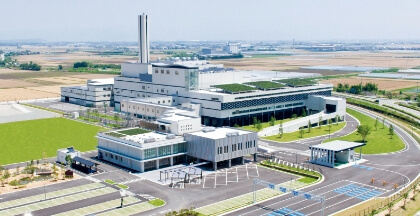
In Chine, where environmental regulations are becoming stricter, and demand for the reduction of global-warming gas emission is growing, there is a trend to adopt waste incineration facilities that convert wastes to energy and conserve environment. Waste incineration plants are being built in several major population centers in China, including Beijing, its capital.
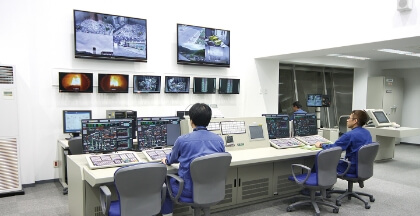
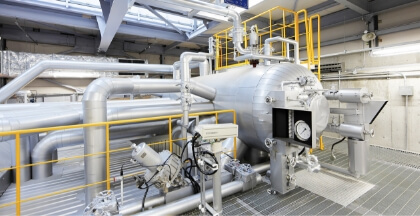
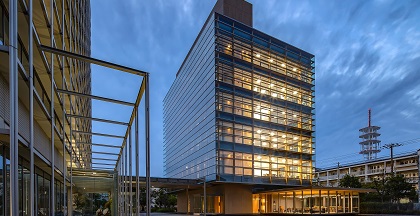
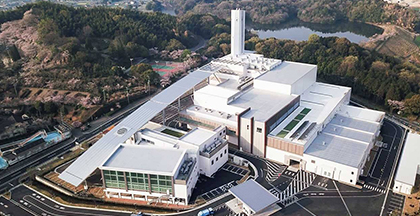
The plant that we have built in Beijing consists of two incineration furnaces, each with the combustion capacity of 800 ton/day. This is the largest ever built by Takuma. For its exhaust-gas treatment, we have chosen the flash dry absorber, forgoing the traditional dry, slaked-lime injection + bag filter system. The plant was completed and the test run was performed without major incident, and it was formally delivered to the customer in July of this year. This article reports on the outline of the plant, and its operation.
(Abstract)
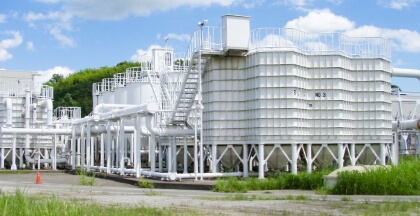
The plant described in this article was permitted in December 2007 as a waste treatment facility primarily to handle medical waste among the industrial waste stream. It was completed and delivered in February 2009 to the customer, Kobe Kankyo Create Co., Ltd.
This plant mainly burns medical wastes that include high-density chlorine-based waste, along with various other industrial wastes. It has a kiln-and-stoker type furnace, and is characterized by its treatment of chlorine, and the feeding system of the infectious waste. This article reports on the results of its operation.
(Abstract)
One of the areas utilizing powerful ultrasonic wave is the technology of liquid atomization that uses submerged ultrasonic oscillator of MHz class. When a submerged ultrasonic oscillator radiates ultrasonic waves into a two-layered liquid of kerosene on top and water below, atomization volume increased fifty percent over the kerosene-only operation. It is assumed that this increase has been accomplished by the lens effect of upheaval at the boundary area of the two liquids that focuses the ultrasound wave, raising the sound pressure inside the kerosene layer. We have also conducted a combustion test, supplying ultrasound-atomized kerosene to an LPG pilot burner flame, and obtained a stable temperature elevation curve.
(Abstract)
We have been developing an alkaline-hydrogen-methane fermentation system for shochu distillation lees that will convert the energy contained in shochu lees into biogas, trying to establish its optimum operating condition. A plant was completed in 2005, and long-term stable operations have been conducted using lees of potato shochu and barley shochu. The energy recovery ratios, the percentages of recovered energy against the sum of energy contained in the shochu lees and the electric power consumption within the system, have been 70.6% with the barley shochu and 63.4% for potato one, both exceeding the original target of 60%. By converting recovered energy into thermal energy by means of the boiler, we managed to reduce the amount of fossil fuels consumption, while lowering the carbon dioxide emission by 62kg per 1m3 of potato shochu lees, and by 98kg per 1msup>3 of barley shochu lees. This has cut the total CO2 emission by approximately 950ton/year. In addition, we haven proven the effectiveness of this system as the operation cost of this plant is lower than the current disposal cost of lees.
(Abstract)
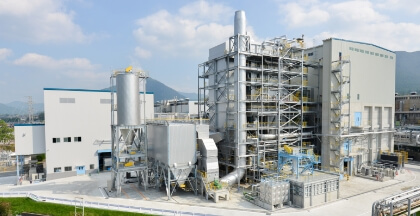
Iwate Clean Center #2, operated by Iwate-Kenpoku Clean Co., Ltd., is a consolidated waste treatment facility consisting of an incineration plant (80ton/day) and a melting plant (13ton/day), built by public financing as a PFI (BOO system) project, a first in Iwate Prefecture. The facility was intended to treat, continuously and properly for 20 years, industrial wastes generated in the prefecture as well as those illegally dumped near the prefectural border. Test operation began in December of 2008 proving stable performance. Its title transfer was completed by March 31, and the commercial operation began on April 1 of this year.
This article reports on the outline of this plant and the result of its test operation.
(Abstract)
While the use of wood biomass fuels is vigorously promoted as a source of new energy suitable for building a low-carbone footprint society, subsequent fuel shortage is of great concern. It is therefore considered essential to establish a dependable supply of the fuel when planning a biomass-firing boiler plant.
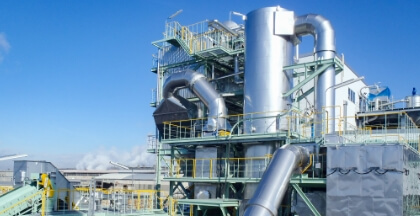
In this article, we report on the outline and operation results of the wood-firing boiler plant we built and started up in June 2009 for Takaoka-Nomachi Factory of Chuetsu Pulp & Paper Co., Ltd. in Toyama Prefecture. This plant is an example of one that uses hitherto unused low quality, off-grade woodchips effectively.