(Abstract)
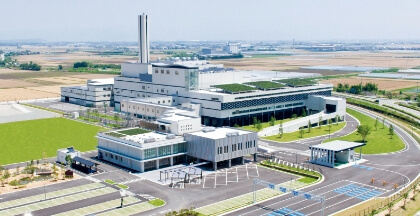
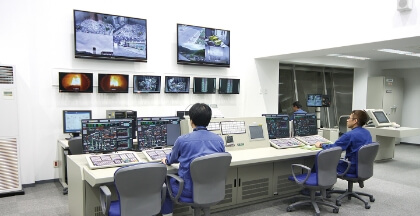
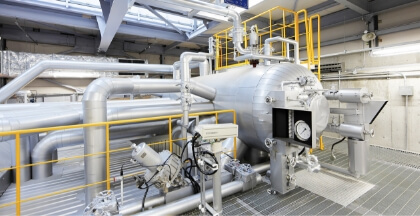
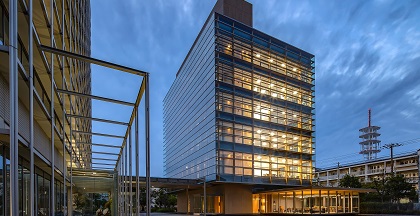
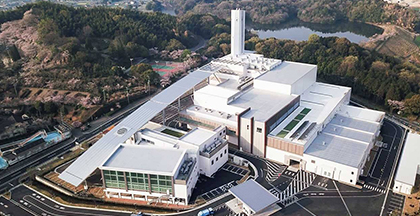
By operating the Environmental Resources Gallery of the Sanitation Control Association of Kakegawa and Kikugawa cities, the following observations have been made. This is the fourth pyrolysis gas melting facility we have built, and was completed in 2005.
1. A stable and continuous operation has been maintained despite large fluctuations in the heat value and the amount of the waste input.
2. Autothermic melting has been achieved.
3. Special attention has been paid to assure longevity of the refractory material of the high-temperature-combustion melting furnace.
4. Iron, Aluminum and slag discharged from the facility are being recovered and reused as reliable resources.
(Abstract)
As a means of preventing global warming, the Ministry of the Environment decided to increase the waste-derived power generation capacity by nearly 50% in the five years from 2008 to 2012, to approximately 2,500,000 kW. It will be an increase of 870,000 kW over the estimated 1,630,000kW for the fiscal year 2007. In addition to building new plants, this may require addition of power-generating capacities to the existing small and medium incineration plants. Most of these existing plants are connected with the high-voltage (6kV) grid. The Grid-Interconnection Guideline for Maintaining Electric Power Quality recommends power-generating facilities with capacities above 2,000kW to interconnect with the extra-high voltage (20kV class) grid. This presents a bottleneck to existing small and medium incineration plants in adding power-generation capacities.
We have designed a power-generation model with a capacity in excess of 2,000kW, and studied the technical factors, and found out that it can be interconnected to a high-voltage grid without significant problems. This report describes the results of the study, and the background thoughts of the guideline.
(Abstract)
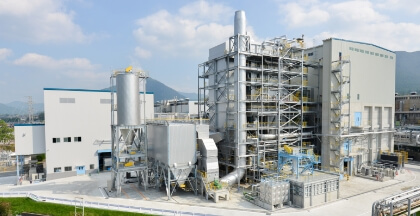
In March 2007 we had received an order from Assist Co., Ltd. to design and build an industrial-waste treatment facility. It was completed in July 2008. This facility consists of an incinerator to treat industrial waste generated within the Nemuro region of Hokkaido, and a calcination plant to process shells from the scallops harvested nearby. We began test operation of the plant in late May 2008. The incineration has been carried out smoothly by optimizing the waste composition ratio, and the calcination plant has reached the required temperature. The performance test that followed has proven that the facility meets the guaranteed design specifications.
(Abstract)
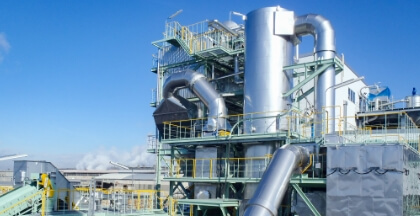
As a part of the Greenhouse Gas Mitigation Technology Development Program 2007 initiated by the Ministry of the Environment, we began in 2007 a demonstration test of producing methanol from biomass. This technology gasifies biomass, and methanol is synthesized from the carbon monoxide and the hydrogen contained in the product gas. It embodies our own technologies such as gasification using circulating fluidized bed, high-temperature ceramic gas filter and tar cracking by means of catalyst, contributing to high gasification efficiency. Compared with the traditional method that produces methanol from natural gas, this new technology not only saves energy by synthesizing methanol at lower temperature and lower pressure, but also improves efficiency by providing a condensation zone in the methanol reactor that forms a non-equilibrium reaction field.
Our demonstration test has achieved the carbon conversion rate of 95% and the cold gas efficiency of 65%, proving high gasification efficiency, while the methanol output has been steady at 50L / day.
(Abstract)
In April 2003 the authors developed a simple method of measuring dioxins using immunoassay as its measurement principle. In September 2005 this technology was designated to be the official method as a part of measuring system of dioxins from the exhaust gas and particulates from waste incinerators. At the early stage, however, this method used an antibody with very low reactivity toward PCBs that limited its application to screening soil and sediments that contain spots of high PCBs concentration.
We proceeded to produce a new antibody against dioxins that reacts very well not only to PCDD/DFs but also to PCBs. This enabled us to develop a new immunoassay kit that screens dioxins-contaminated soil and sediments quickly and cheaply.
In this article, we report the measuring principle and characteristics of the newly developed immunoassay technology.